
Sound insulation with glass walls in the office: what is realistic and what it depends on
Sound insulation
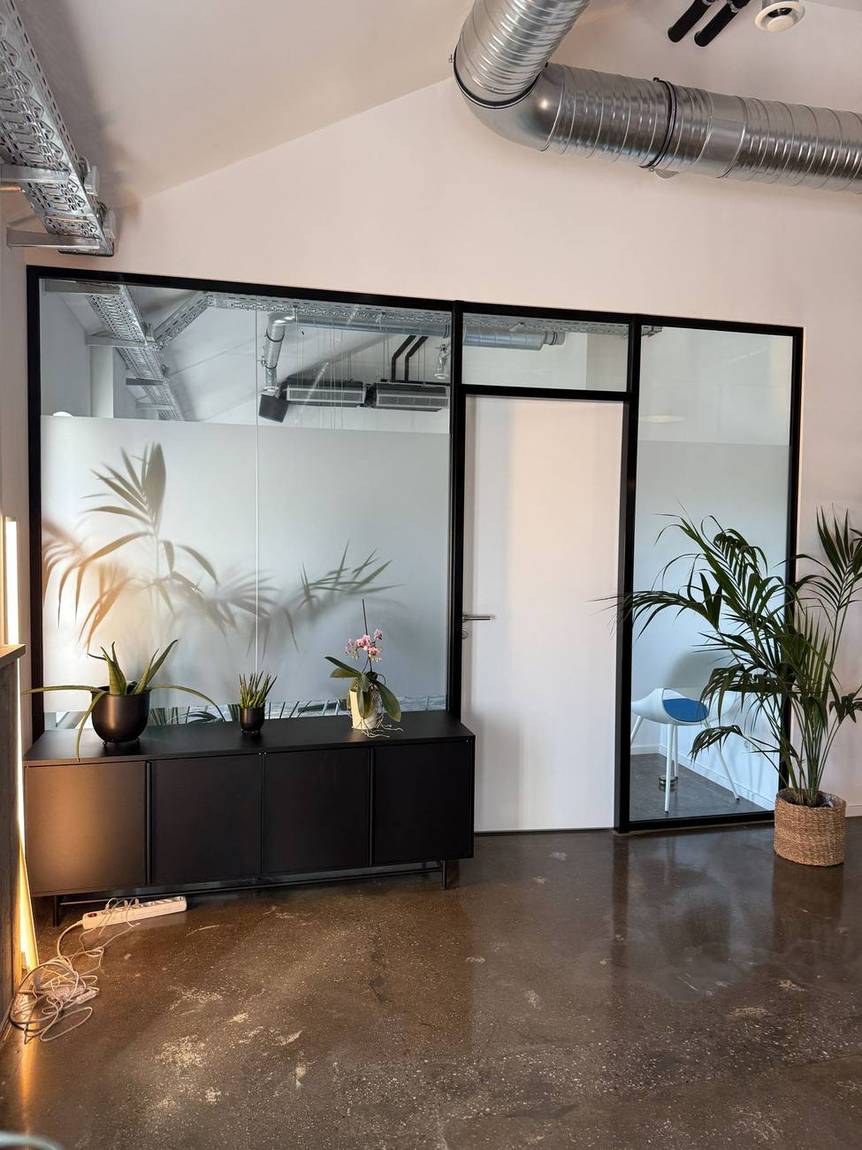
Anyone who wants to put a glass wall into an office almost always asks this first: will you still hear everything? The honest answer has two parts. Glass can do more than most people think. And what finally reaches the room does not depend on the glass alone.
What you really hear in the room
Hardly anyone can do much with numbers. So first, here is what you can expect in practice when people next door speak at normal conversation volume and the door is closed:
- Glass wall with 10 mm laminated safety glass and acoustic interlayer: You can hear that someone is speaking, but you can no longer understand a word. Even at a distance of one metre you have to concentrate hard, and you cannot really make out anything.
- With 12 mm: The effect is clearly stronger. You have to go right up to the glass wall to pick up anything at all.
- With 16 mm: You still notice something, but you really cannot understand anything any more.
This is our experience from installed walls, not a measured value. How well it works in an individual case depends on the building.
The laboratory values
If you want to know exactly: the manufacturer of the acoustic interlayer states the following weighted sound reduction indices (Rw) for laminated glass in the laboratory. The glass thicknesses are given per pane; a build-up of two times 5 mm corresponds roughly to our 10 mm glass.
| Build-up (per pane) | Roughly our glass | Rw in the laboratory |
|---|---|---|
| 5 mm + 5 mm | 10 mm | 38 dB |
| 6 mm + 6 mm | 12 mm | 39 dB |
| 8 mm + 8 mm | 16 mm | 41 dB |
Source: data sheet of the interlayer manufacturer, measured as a glass sample without a mounting system. The values are guide values.
Why it is less in the building
Laboratory values apply to the glass sample alone. Once installed, they are a few decibels lower, because sound also travels on via the ceiling, walls and floor, as structure-borne sound through the building. In our quotations for the 10 mm glass with acoustic interlayer we therefore state 35 dB.
Exactly how much is lost depends on the building: how the walls, floor and ceiling are constructed, how the structure-borne sound is transmitted and whether there are door openings in the wall. We tell you that after the site survey, not before.
The door is often the weak point
In a glass wall with a door, the door very often has a say. With our system, a glass door goes up to a maximum of 10 mm laminated safety glass. Thicker glass would put too much load on the wall.
Where the sound insulation needs to be higher, we therefore work with closed wooden doors with sound insulation. They have a higher insulation value than a glass door.
For sound insulation we rely on hinged doors with seals, because they are tighter against sound. Sliding doors are also possible, but not the first choice for high sound insulation: by design, openings arise so that the door can be slid to the right and left, and more sound gets through there.
An example from a law firm in Mülheim an der Ruhr: there we built the glass wall and installed a class 3 sound-insulating door leaf, which insulates clearly better than a glass door.
The glass wall was additionally covered with a frosted film to create a little more privacy at eye level.
What we recommend
For normal everyday office use the standard wall is enough. For law firms and medical practices we recommend at least 38 dB, i.e. one step higher. The reason is simple: there, a conversation has to stay a conversation.
What the glass wall gives you
Daylight stays throughout the room, and yet it is quiet enough for phoning and advising. The wall divides the room acoustically without making it dark.
Anyone who wants absolute silence needs a solid wall. We say so openly. Anyone who wants a bright room in which you can work undisturbed is in the right place with us.
Frequently asked questions
Do you hear everything through a glass wall? No. With the door closed and at normal conversation volume, our standard build-up lets you hear that someone is speaking, but you cannot understand a word.
Which glass do you recommend for law firms and practices? At least 38 dB, i.e. one step above the standard, plus a closed wooden door with sound insulation.
Why not simply use a thicker glass door? With our system the glass door goes up to 10 mm laminated safety glass. Thicker glass would put too much load on the wall.
Can I get an exact dB value for my office beforehand? We state the exact value after the site survey, because it depends on the building.
You can find more about our system on the glass walls page. For a binding quotation, please use our glass wall enquiry.