
You type "office glass wall" into Google and get a hundred results. A system house with a catalogue. A main contractor. A metalworker. A shopfitter who offers glass walls on the side. And three ads from companies four hundred kilometres away.
The problem is not finding someone. The problem is telling them apart. Everyone writes "made to measure". Everyone shows the same handsome photographs. And you only see the difference once the wall is standing.
This article is meant to save you that work. It tells you what kinds of supplier exist, what each one is good at, which questions settle the matter in the first phone call – and how to tell that you had better keep looking.
Three kinds of supplier – and what each is good for
There is no single right supplier. There are three types, and which one suits you depends on what you are building.
The system supplier. Sells a finished system from the catalogue. Fixed grid sizes, fixed profiles, fixed door sizes. The parts come off the production line and an installation crew puts them up.
That is fast, easy to cost and often inexpensive. It works if your building is new, the walls are plumb, the floor is level and you can live with the grid sizes. In a new build with straight axes that is often exactly the right choice.
It does not work when something falls outside the pattern. An old building with crooked walls. A ceiling that drops twelve centimetres. A rounded corner. A door that has to be wider than anything in the catalogue. Then it is: "We don't have that in our range."
The middleman. Takes the order and passes it on. This may be a main contractor, a dealer or a sales company without its own workshop. The price is often fine, the handling usually clean.
The catch: you never speak to the person who measures, and never to the person who installs. If something on site differs from the plan, every decision travels across two desks. That costs days. And if something has to be put right later, the search for who is responsible starts all over again.
The specialist firm that measures, builds and installs itself. The same firm takes the measurements, plans the wall, orders the glass, arrives in its own vehicle and puts it up.
It is rarely the cheapest option. It is the option where there is one point of contact and where custom sizes are not a special case.
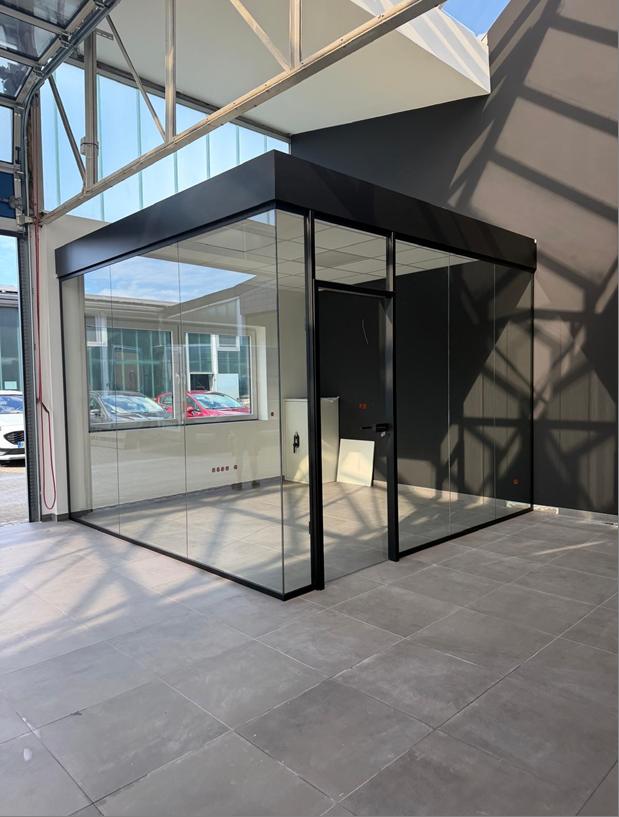
We belong to the third group. That does not mean the other two are worse. It means we are built for different tasks.
"Made to measure" is not a protected term
Anyone may write that. There is no testing body for it and no definition anyone would have to keep to. A system supplier who adjusts your wall in 25-millimetre steps writes "made to measure" just as readily as a firm that measures every pane individually.
So there is no point searching for the phrase. There is a point in asking about it – and asking in a way the answer cannot dodge.
Six questions for the first phone call
Together these six questions take less than ten minutes. They sort the suppliers more reliably than any website.
1. Who takes the measurements – and when?
The decisive question. Does someone come out before anything is ordered? Or is it made from your drawing, leaving you to carry the risk if the room turns out different from the plan?
Measuring before ordering is the difference between a wall that fits and a wall that has to be made to fit.
2. What do you do if the wall is out of plumb?
That is the test. No existing building is straight. Anyone who answers "we'll have a look" has not done it often. Anyone who explains how the junction with a crooked wall is solved knows what they are talking about.
How that is done we have written up in a dedicated article written up.
3. Are custom sizes possible – or is there a grid?
Ask specifically: what is the largest pane you install? What happens at a rounded corner? Can you fit a door wider than a standard size? The answer "we'll sort that out later" is an answer too.
4. Who installs – your own people or subcontractors?
No value judgement, but a difference. Your own fitters know the system, have put it up a hundred times and know what to do when something does not fit. A changing crew starts from scratch on every site.
5. Which glass, and why that one?
A good supplier tells you unprompted which type of glass they use and why: toughened safety glass (ESG) or laminated safety glass (VSG), what thickness, and whether anything has to be barrier glazing. Anyone who just says "safety glass" either cannot be bothered to explain or has not thought about it yet.
6. Who comes out if a pane breaks two years from now?
Glass breaks. On site, during a move, when furniture is shifted. What happens then is not decided when the damage occurs but when the supplier is chosen. Ask how long a replacement pane takes and who fits it.
Five warning signs
A price without measuring. Anyone who quotes you a square-metre price on the phone and leaves it at that either has a rigid system or will recalculate later. A guide figure for orientation is fine – a binding quotation without measuring is not.
"Frameless glass installation" as the answer to everything. Frameless glass installations are a construction type of their own, in which the door too does without posts. Not everyone who uses the term actually builds one. Ask what exactly is meant. We deliberately do not build them – our doors sit in a system door frame between two posts, and we say so up front.
Acoustic figures with no context. A dB figure always belongs to a specific assembly tested in a laboratory. What reaches your room is lower – sound travels through the ceiling, the floor and the flanking walls. Anyone who quotes you a figure without saying so is selling you a number, not a wall.
No questions about the site. How do the panes get into the building? Lift, stairs, window? Which floor? When is installation allowed? Anyone who does not ask that has not thought the installation through.
No trade register entry, no address. A firm with no address in its legal notice, or that is unwilling to give you its entry in the German trade register (Handwerksrolle), is not a good start. The Handwerkskammer will confirm it.
Why the region counts – and when it does not
Regional does not automatically mean better. We install across the whole of Europe ourselves, and on a large project the distance matters less than the question of whether someone has built it before.
On small and medium projects it is the other way round. There, proximity counts, for four plain reasons:
- The measuring. Someone from the region drops by for an hour. Someone 600 kilometres away builds the journey into the price or works from a drawing.
- Shifting dates. Site schedules shift. A firm nearby can reschedule. A firm that has to travel a week in advance cannot.
- Putting things right. A small adjustment that has to be made is half a morning for a firm from the region. For one far away it is a calculation.
- The replacement pane. See question six.
What to have ready for a solid quotation
The more of this is on the table in the first conversation, the sooner you get an answer you can rely on:
- Width and height of the area – a rough measurement is enough to start with
- Site location and floor
- Should there be a door? Single or double leaf?
- Is acoustic insulation needed, and what exactly for – phone calls, meetings, staff conversations?
- New build or existing building?
- Preferred installation date
- Two or three photographs of the situation
Photographs are worth more here than most people think. In ten seconds a specialist sees things in a photograph that appear in no description.
One thing about the contract
The warranty period differs depending on what the contract says. For work on a building it is five years under the German BGB and four under the VOB/B. If an offer says "the VOB/B applies", you now know what that means. This is not legal advice – but it is one line worth reading.
And if you are near us
We are based in Borken in the western Münsterland, right on the Dutch border. From there we are regularly out in the Münsterland, the Ruhr area, the Rhineland and the Netherlands – and just as regularly on projects right across Europe.
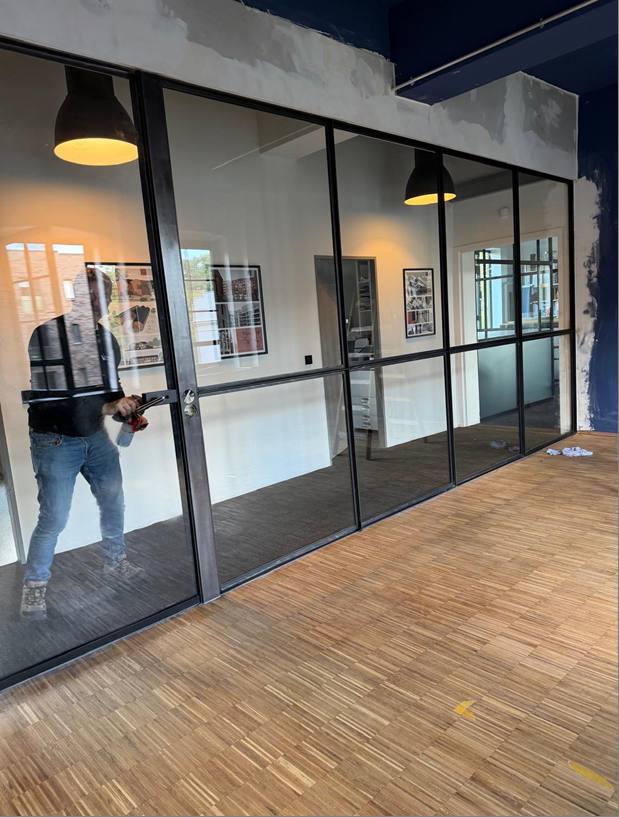
What we do is set out above under the third group: we take the measurements ourselves, plan the wall ourselves, install with our own people and are the point of contact if anything comes up. Our system is called WESSELER W-LINIE 2 and was developed here. What it can and cannot do is set out on the glass walls page and in the data sheet you can download.
You can put the six questions above to us just as you would to anyone else. That is the whole point.
If you have a project: call us, that is the quickest way. Or write to us using the contact form – then the right field is already set and your enquiry goes straight to the right person.